Profile
Evgeniy Lapchenko
Ukrainian painter — born Severodonetsk · Luhansk · Kyiv · San Francisco
Biography
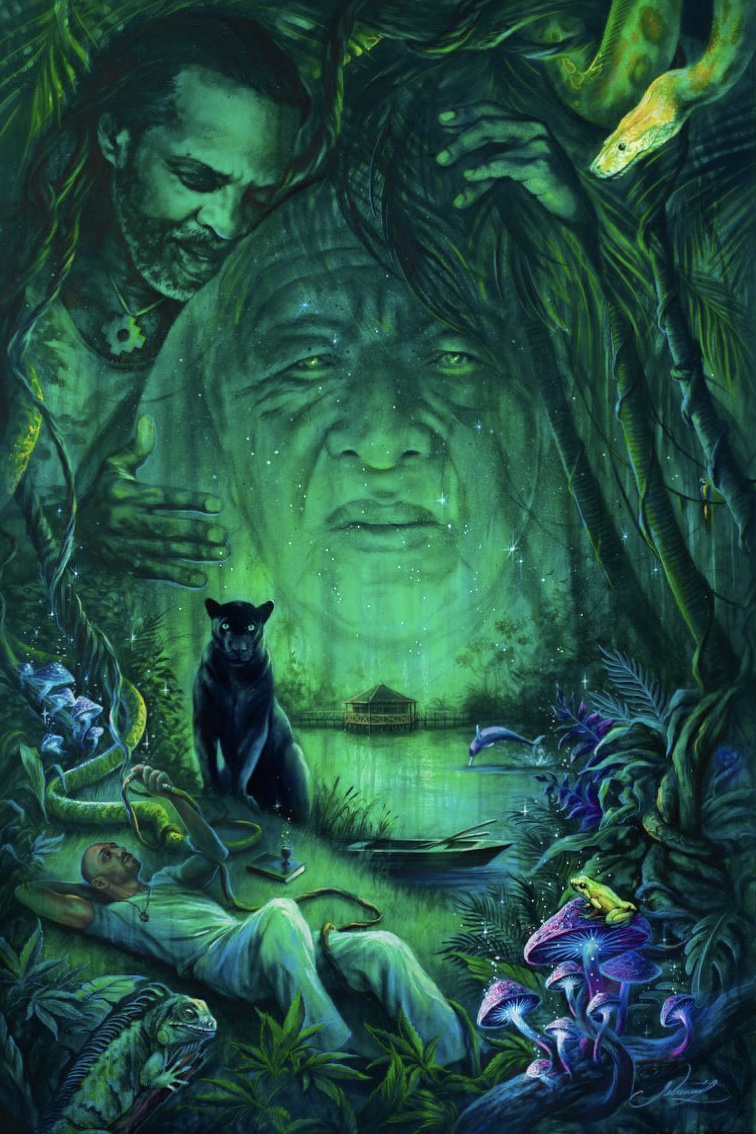
A painter working between classical figuration and contemporary myth.
Evgeniy Lapchenko was born in Severodonetsk and formed as an artist across Luhansk, Kyiv and San Francisco — a geography repeatedly remade by movement and crisis. That instability runs through the work: it takes an overloaded world and reassembles it into a deliberate visual order.
He treats the classical tradition not as something to restore but as a working instrument. He takes an image culture already knows and returns it to the present. The faces change, the technology sharpens — the hunger does not. Desire, vanity, spectacle and spiritual longing stay at the center.
His best-known work, Garden of Earthly Delights, was created for the 906 World Cultural Center / Hack Temple in San Francisco — a former Catholic church on Broadway turned cultural and technological space. Reworking Bosch's triptych for the algorithmic age, it became a new kind of altar for a new kind of temple.
Recent work extends the studio into film and public installation — a long inquiry into ritual, image, and the modern self.
Chapter 01
A painter of modern icons
Lapchenko works with the classical tradition not as a museum restorer, but as an artist of new iconography. He takes an image that culture already knows and returns it to the present. Faces change. Costumes change. The technology becomes more refined. The hunger does not.
His paintings read less like quotation and more like diagnosis. A Lapchenko work can feel like a fresco, a film frame, an altar, a social network, a confession and a warning system at the same time.
Chapter 02
San Francisco: where Bosch met Silicon Valley
One of Lapchenko's defining works is Garden of Earthly Delights, a large contemporary triptych created for the 906 World Cultural Center / Hack Temple in San Francisco. The project occupied a former Catholic church at 906 Broadway and transformed it into a cultural and technological space.
The point of departure was Hieronymus Bosch's triptych of c. 1500–1510. Lapchenko did not make a copy. He created a new reading of the structure: paradise, earthly pleasure and hell translated into the language of the twenty-first century — founders, prophets, celebrities, fictional icons, festivals, machines and the mythologies of Silicon Valley.
If Bosch painted the moral imagination of his age, Lapchenko painted the algorithmic temptation of ours.
Chapter 03
The language of transformation
Lapchenko is drawn to the moment when a form stops being stable: a sacred building becomes a cultural lab; an old master becomes a contemporary system; a personal crisis becomes an image; a painting becomes a portal.
The fracture is not erased. It is made visible — and the visible fracture is what allows the figure to broadcast at all. The artist does not hide rupture; he turns it into structure, and the structure becomes the signal.
For collectors, the important distinction is simple: a decorative painting solves a wall. A Lapchenko work opens a field.
Positioning
Editorial · 04- Ukrainian painter of new mythological realism
- Places him between classical craft and contemporary symbolic narrative.
- Author of modern icons
- Frames the work as more than image-making: the construction of shared cultural symbols.
- Painter of the technological age
- Connects Bosch, Silicon Valley, mass culture, spirituality and post-digital identity.
- Artist of transformation
- Links biography, rupture and the rebuilding of form into a new whole.
Selected Projects
- Garden of Earthly Delights — 906 World Cultural Center / Hack Temple, San Francisco
- Contemporary triptych after Bosch — installed at 906 Broadway
- Studio — Italy
Press & References
- balbek bureau — 906 World Cultural Center
- ArchDaily — 906 World Cultural Center / balbek bureau
- Behance — 906 World Cultural Center project
- San Francisco Chronicle / SF Magazine
- Courrier International · Exame — NYT-sourced reprints, Hack Temple
Editorial Note
- Lapchenko's Bosch-inspired triptych at 906 World Cultural Center in San Francisco was documented by leading architecture and design publications.
- The Hack Temple context appeared in international reprints of a New York Times-sourced story.
Full CV, high-resolution images and press kit available on request.
Request Materials →